Travel Power Banks

Flight- Safe Power Banks - Great For Your Travel Lifestyle!
The Best Travel Power Banks:
My INIU Lineup
Never thought I would say this - If there's one thing I never leave home without, it's backup power.
Don’t know why, because GenX’ers are always adapting to new technology.
Nothing worse than a dead phone in a foreign airport, dying camera mid-sunset, no way to pull up your hotel confirmation because your battery gave out. We've all been there. The good news is that it's completely avoidable. Let's Dream a little less about staying charged and actually Plan for it.
I'm adding INIU power banks to my back up power options. Depending on the day’s adventures or how many devices I’m traveling with, each one of these has a purpose for different reasons.
Meet the Lineup
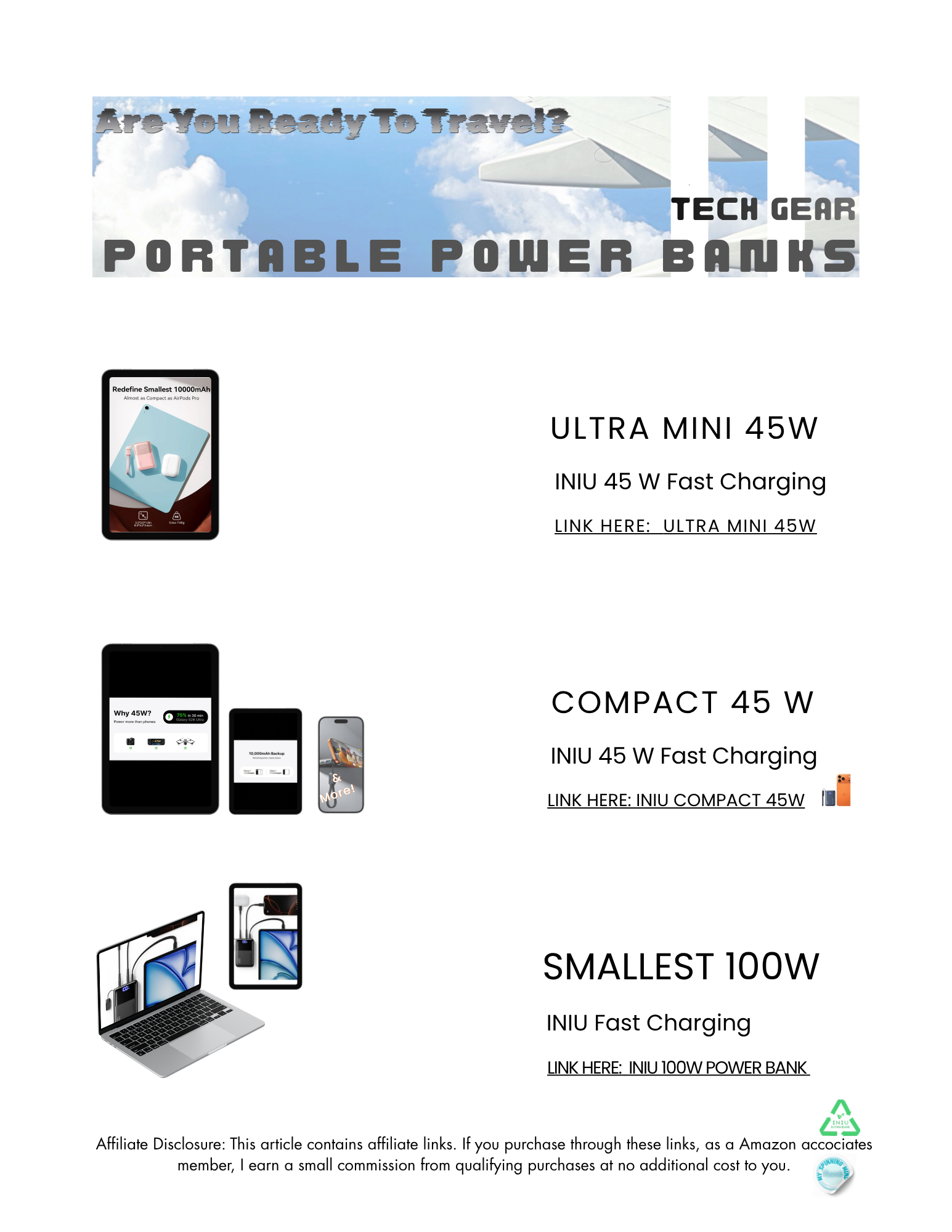
1.) INIU Ultra Mini 45W Power Bank
It's roughly the size of an AirPods Pro case and has the cord attached. It's the bank I grab for a day out and about or a day of sightseeing. It’s easy to hang off of my daypack loop or key chain and keep in my pocket.
Click on ULTRA MINI 45Wfor link.
2.) INIU Compact 45W Power Bank
Similar to the Ultra Mini, I bring the Compact for longer trips. It’s small enough to live in my purse or backpack pocket permanently, yet strong enough to fast-charge a phone or tablet at nearly full speed. The bonus - it comes with a detachable USB-C cable so you're not hunting for the cords!
Click on COMPACT 45W for link.
3.) INIU 100W Power Bank
The "smallest" high-capacity option.This is my workhorse for when I need my laptop and rely heavily on technology when I’m working while traveling. Currently the highest flight-safe/watt-hours (Wh) - 100W output that can fast-charge a laptop.
Click on FAST CHARGE 100W for link.
For your connivence and added disclaimer, the Amazon associate affiliate links above allow MySpinningMindTravels to earn a small commission if you purchase - At no extra cost to you. Thank you for your support.
Pros and Cons
1. Ultra Mini 45W / 10,000mAh
Pro’s:
Fits in your pocket. Great for concerts, hikes or any day where a bag isn't practical.
Same 45W output as the Compact, so you're not sacrificing charging speed for size.
Detachable cable means less clutter and easy cable swaps.
Con’s:
It's a top-off device, not an all-day power plant.
2. Compact 45W / 10,000mAh
Pro’s:
Fits on a hook or in a daypack or purse without adding noticeable bulk.
Detachable cable means less clutter and easy cable swaps.
The 45W is plenty to fast-charge a phone, tablet, game gear and more.
Con’s:
Not enough juice to meaningfully charge a laptop.
You'll likely recharge it every day or two on a busy trip.
Ultra Mini & Compact - Built for travel, ready for everyday devices. Airline friendly power works with phone, tablets, earbuds, drone and gaming gear.
3. 100W / 25,000mAh
Pro’s:
Can fast-charge a laptop and more. Useful for remote workers & digital nomads.
Highest capacity on flights, currently. Good for heavy use, multi-day trips or when outlets are scarce.
Smaller than most power banks in its capacity class.
Cons:
Still the heaviest and bulkiest of the three listed above — this is a "bring it in your carry-on personal item," not a "clip it to your belt" bank.
Overkill if you're only ever charging a phone, but who has just a phone anymore?
Is It Actually Flight-Safe? The Math
Every power bank on this list is allowed in your carry-on (at the time of this writing). The why is worth understanding so you're never caught off guard at security.
The TSA and FAA care about the watt-hours (Wh). Current rule- If the battery is rated at 100Wh or less are allowed in carry-on without any special airline approval. Between 101–160Wh, you need the airline's okay in advance. Anything over 160Wh isn't allowed on passenger flights at all.
Here's the quick formula: Wh = (mAh ÷ 1000) × voltage (power banks run on 3.7V nominal).
The 100W 25,000mAh bank works out to about 92.5Wh — under the 100Wh line, no approval needed.
Both 45W 10,000mAh banks work out to about 37Wh — well under the limit.
All three listed above on my list are comfortably inside the "no paperwork required" zone, which is exactly why I chose them.
The rule that trips people up is that Power banks can never go in checked luggage. Only carry-on or your personal item. If your bag gets gate-checked because the overhead bins are full, you have to pull the power bank out and put it in your personal bag or carry it to your seat.
What's new: As of May 1, 2026, American and Delta both cap passengers at two portable chargers, each 100Wh or under and require them to stay visible and within reach. They can not be tucked in the overhead bin and not left charging unattended during the flight. Southwest's policy is even tighter, limiting passengers to one charger under 100Wh. Check for current updates before you travel.

Learn more information on INIU – Professional Waste Recycling:
How Eco-Friendly Are They, Really?
Here is a honest discussion, not a greenwashed one. As we all know a lithium-ion power bank isn't a "green" product. It's manufactured, uses mined materials and it will eventually need proper e-waste recycling.
Where these do genuinely help your footprint:
They reduce disposable battery use. No more buying throw-away cords or batteries when you can top it off from a bank you already recharge.
Fewer, better devices. INIU's smaller footprint per capacity means less material overall compared to older, bulkier designs with the same output. Currently they’re giving us a 3-year warranty means they are expecting them to last.
ECO Packaging. Plastic Free.
Avoid cheap or unbranded power banks. Look for certified models that follow strict safety standards.
The truly eco-conscious move is the boring one: buy one good power bank, use it for years and then recycle it properly through an e-waste program. Don't toss it in regular trash - lithium batteries are a fire risk.
Pack Them & Use Them - Every Day & On The Road
Match the power bank to the days activities. Long transit day or laptop work from a café? Bring the 100W. Sightseeing with a small bag? Ultra Mini. Everything in between? The Compact 45W, that is the one I default to most of the time.
Purse, backpack or personal item bag – Think about purchasing a fire proof bag. Never store them in a inclosed space, checked bag or overhead bin. Keep updated on all airline/train/buses rules when traveling. Label them - with Wh limits tightening, knowing which bank is which at a glance may save you a time at security or check-in’s.
Get organized and plan ahead. Make it a habit to charge them at night. A power bank at 20% is just almost useless. Do you have a home base charging station? Having a designated charging station is the best organization and design feature that you can have in your home or your home away from home.
Which Ones are Best for You?
If you're building your own kit, get the new updated designs that use less materials and are easier to pack and use.
Grab the Ultra Mini as your no-excuses, always-in-your-pocket phone or earpod backups.
The Compact 45Wif you want one to charge multi devices (except a laptop).
Use the 100W if you travel with a laptop or longer trip with limited outlets.
Dream! Plan! Go! Live It!
This website participates in affiliate marketing programs and as an Amazon associate member I earn a small commission if you click on My Spinning Mind Travels links and make a purchase. Thank you for your support. This article is not sponsored.